Archive for the ‘Craft of the Video Shooter’ Category
 I’m Missing the Connection Here
The data and power cables poking in and out of my MacBook Pro are pure crap. Take a look at how I’m managing my AC charger cord. I’ve added three cable ties over a sleeve of black camera tape to ensure adequate stress relief and thus forestall the eruption of arcs and sparks from the broken connection.
Why can’t cable manufacturers simply provide sufficient stress relief in the first place?
The matter of diseased trouble-prone cables is not a new phenomenon. After 35 years in the business I know from hard-won experience that 90% of failures in the field are due to defective cables and connectors. Thinking about it now my ARRI 16SR in 1976 was a true godsend. The camera utilized onboard batteries that eliminated completely failure-prone cables and plugs. It gave me great peace of mind that this disproportionate cause of failure was gone forever.
Thunderbolt is an impressive technology and we’ve grown to rely on the less than robust cables for our most critical tasks from off-loading original camera footage to preparing our backup volumes. With data rates up to 40Gbps in Thunderbolt3 the flow of data is sensitive to a range of cable snafus, especially at the point where the cable enters the rigid connector where most failures due to fatigue occur.
For manufacturers, the cost of producing cables with proper stress relief might amount to a few pennies per unit, but as shooters and content creators whose business is capturing, transferring, and managing critical data, the extra dollar or two per cable at retail is worth it, if only to avoid the indignity of having to affix a raft of cable ties simply to ensure a solid and reliable connection.
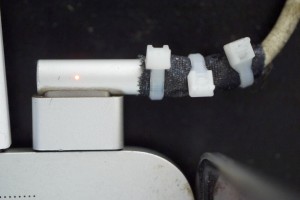
A cable usually fails at the point it enters the solid connector. Affixing a series of plastic cable ties can provide increased stress relief and help forestall an intermittent connection.
A New Kind of Package Lens
One of the truisms of our profession has long been a camera system is only as good as its optics. While computational non-optical lenses in devices like the iPhone have obviated the need in some applications for finely crafted optics, the demand persists for high-performance glass at the high end of our business, especially in light of the latest 4K and higher resolution cameras.
The new Sony PXW-FS7 4K camcorder is well-balanced and robust, with superb ergonomics. Particularly notable, however, is Sony’s own 28-135mm F4 lens that comes with it. It is not the typical crappy package lens that usually accompanies new mid-range cameras.
Employing precisely sculpted aspheric elements and low-dispersion glass the FS7 4K zoom represents a real breakthrough in economical s35mm lens technology. Remarkably free of chromatic aberrations – the main reason cheap lenses look cheap – the lens compares favorably with much pricier optics; its relatively slow F4 maximum aperture posing less of a challenge these days for shooters employing cameras like the FS7 that shoot virtually noise-free at ISO 2000 and higher.
Sony’s lens uses precise servo control of zoom and focus to enable a constant F-stop throughout the zoom range. Some shooters will object to the limited 5:1 zoom for documentary work but keep in mind the lens is a large format zoom. If you’re looking for a 23x capability you should consider a 2/3-inch camera like the Varicam HS, which is ideal for travel and sports, and certain wildlife titles, that tend to employ long zoom telephoto lenses.
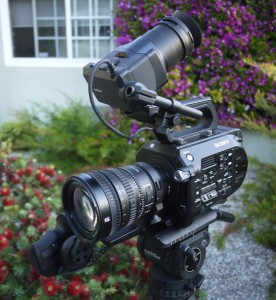
Sony’s new 28-135mm E-mount zoom offers very high performance in an economical S35mm format lens.
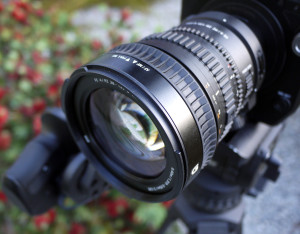
The zoom even at maximum magnification is remarkably free of chromatic aberrations.
Exclude! Exclude! Exclude! Takes on New Meaning
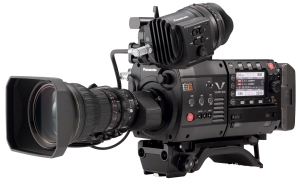 With the advent of cameras like the extreme low-light ISO 5000 Varicam 35 the imperative to exclude, exclude, exclude, unhelpful story elements inside the frame takes on a more dramatic dimension. Shooting with the new Varicam in very low light at night, for example, means that streetlights suddenly appear blown out, the night sky over major cities is way too bright, and the intensity of incidental TV monitor and screens in the background must be substantially reduced.
This way of working is a revolution in how camera folks have managed the world until now. In the film days of years ago we needed light and plenty of it to gain even a minimum exposure. Moderately sensitive digital cameras like the Alexa of several years ago gave us the freedom to illuminate scenes with smaller low-wattage, more economical, cooler units. A blessing to be sure!
Today given the latest ultra sensitive digital cinema cameras entering the market we are back to spending a lot of time addressing the lighting in our setups, not so much by adding massive hot lights of course, but by employing more extensive lighting control, that is, by taking light away.
Given the new technology my old harangue to students to exclude everything not supportive of the visual story has taken on even greater relevance and urgency.
Children of the Desert
I’m in Abu Dhabi this week continuing my ongoing travels around the globe offering camera workshops and pontificating about one irrelevant thing or another. This morning a major sandstorm blew in from Saudi Arabia and completely enveloped the NYU campus where I’m currently holed up.
The extremely fine sand less than 50 microns in diameter is highly abrasive and can lodge dangerously deep in one’s lungs. It is also damaging to cameras and especially camera lenses, a lesson learned the hard way by many filmmakers and shooters in the region who are drawn inexorably, like I am, to the eerie other world feeling imparted on the landscape.

Emirati children visiting the NYU campus in Abu Dhabi navigate an early morning sandstorm 3 April 2015.
The Lesson Taught & Learned
This week I am teaching a camera storytelling workshop at the London Film School. My students enrolled in the masters program here seem motivated and especially eager to embrace my lessons of life, business, and the camera craft.
For me offering such workshops at schools and universities around the world is a way of giving back. My mentor, Albert Maysles, who died earlier this month at 88, made it a point every year to spend a few weeks sharing his prodigious expertise with aspiring young filmmakers.
I am grateful to be able to follow in my mentor’s footsteps.
Vishen Lakhiani, the great entrepreneur and founder of MindValley in Kuala Lumpur, often speaks of the threes pillars of happiness. To find happiness in our lives, he says, we need to have a wealth of experiences. We need to feel we’re growing each day. And we need to know we are contributing in some way, somehow, to the betterment of others.
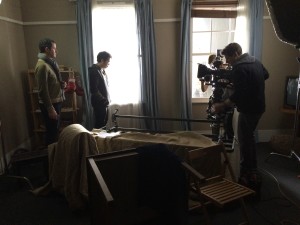
London Film School Camera & Visual Storytelling Workshop with Barry Braverman 20 March 2015
Albert Maysles, my mentor, RIP
My mentor Albert Maysles died yesterday at the age of 88.
I will remember him fondly.
In 1976 Albert Maysles urged me to make Murita Cycles, a film about my very unconventional dad. He said the best documentaries are made by folks who are the closest to their subjects.
At the time Al was riding the trains around America carrying his modified 16mm Auricon and tiny (for its time) Nagra SN recorder. Utilizing his direct cinema approach he wanted to capture strangers meeting and getting to know each other on their respective journeys.
I don’t think he ever completed that project but he sure did complete many other great works.
I will miss him. He was a great filmmaker and a great source of inspiration in my life.
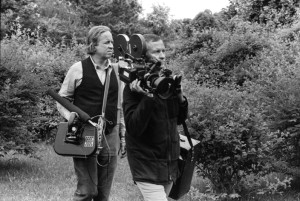
Albert Maysles (right) with his brother David, in the 1970s.
Smaller Is Better Sometimes
If your bread and butter is shooting news, non-fiction, or documentaries, which covers at least three-quarters of us, a smallish-sensor camcorder fitted with a 1/3-inch, ½-inch, or 2/3-inch sensor makes a lot of sense.
Sony’s new PXW-X180 fitted with a 1/3-type sensor means in terms of imager size you can actually find and hold critical focus at the long end of its long 25X integrated zoom. I admit the whisker-thin narrow depth of field look currently in vogue offers some storytelling advantage: a blurry background with a shallow focus can help direct the viewer’s eye to what’s important inside the frame.
For documentary non-fiction shooters however our emphasis ought not to be so much on achieving the least amount of depth of field but rather how to capture the most compelling close ups. For those of us who earn a living every day in the non-fiction genre we know that close ups account for 80%-90% of our storytelling, which usually require longer focal length lenses with an inherently narrow depth of field.
Thus the full-frame sensor so ardently demanded by many shooters today may work against the exercise of a documentarian’s good craft; the extreme narrow focus in close ups may render such critical scenes objectionably soft, and thus communicate an amateurish feel to viewers.
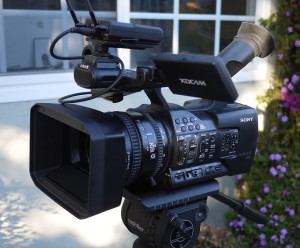
Sony’s new PXW-X180 features a very out of fashion 1/3-type sensor. Just what you may very well need for your next documentary project!
LEDs Are the Future But Some Specialized LEDs Have Problems Now
The current trend to use LED lighting exclusively on feature films and high-end commercials has carried with it some interesting dichotomies. On the one hand the advent of LED instruments designed for cinema applications like the Litepanels remarkable new Astra 1×1 delivers a very bright flattering light with an exceptionally smooth color output. The RGB/RGBW LED fixtures on the other hand increasingly requested by DPs tend to be borrowed from live theater and stage. The use of such lighting for feature production introduces a bevy of potentially serious problems; the dimmed output as low as two percent in my latest project contributing to a pronounced flicker that can be most difficult to read and compensate for.
Shooting in Japan and Singapore in August and September I found myself capturing the movie’s behind-the-scenes featurette at 29.976FPS with various shutter settings of 216º, 225º, and 230º, the middle setting seeming to me especially illogical given the 50Hz operating environment. The syhchro shutter in professional cameras can of course accommodate virtually any setting no matter how weird; the real problem is addressing the other discharge lighting that may be present in a scene like the rear projection screens in my particular operating at 24FPS (actually 23.976FPS) that require a shutter of 230º, the neon, fluorescent, and even the studio house lights that require 216º, and the RGB LEDs that would strobe obnoxiously if not captured at 225º.
With new suitably designed flicker-free LED fixtures entering the market from Litepanels, Kino Flo, and others, one can finally see some hope at the end of the tunnel for keeping all of this. Once the same manufacturers introduce RGB fixtures with the same flicker free characteristics we as shooters will be finally able to escape the LED flicker menace once and for all.
After my experience over the last ten weeks I for one am eager to embrace a more orderly RGB LED shooting environment.
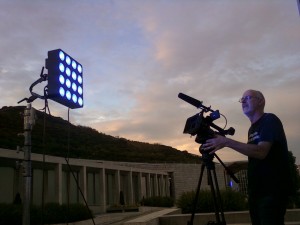
Shooting with RGB+blue LEDs is becoming increasingly common given the current trend. The potential introduction of annoying flicker is a threat that requires constant vigilance.
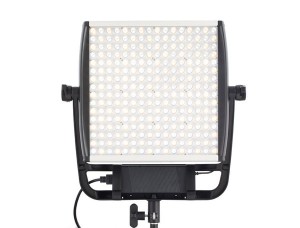
We need a wider range of flicker-free LED instruments like the new Litepanels Astra. Will the company introduce an RGB version? I hope so.
The Demand for Uncoated Optics
Normally when light strikes a glass surface a portion of the beam is reflected. This loss of light is compounded in lenses with many elements, which can lead to a serious reduction in light transmission and speed. More and better lens coatings can reduce the light loss dramatically enabling lenses to maintain high speed with good resolution.
Now it may be a figment of my imagination but lately it seems more and more DPs are employing uncoated lenses. At a time when 4K and higher resolution cameras are all the rage and most shooters are indeed insisting on them it strikes me as deeply ironic and even macabre that many shooters are choosing to capture images with vastly increased flare and much much less resolution.
Of course, resolution, like wardrobe, music, and everything else, is and always has been another function of the visual story. For decades shooters used diffusion filters, metal gratings, and silk stockings, to effect a scene, to add fog or atmosphere, and yes, reduce resolution.
The great director Sidney Lumet once said that story is the conduit through which all decisions flow. The lowering of resolution is simply another storytelling device to be used and abused by shooter-storytellers of every stripe. The use of uncoated optics (as in the case of my current project shooting in Japan) is simply a reflection of this craft-oriented thinking.
A Flicker of Truth
Whether you’re shooting time-lapse, fast or slow motion, or even more routine scenes under temperamental fluorescent lighting, chances are you’ve confronted flicker and have thrown up your French flag in frustration. Today the flicker menace seems even greater owing to most cameras’ tiny viewfinders that make it difficult to spot on location, increased use of LEDs and other discharge lighting, and greater availability of cameras capable of shooting at off frame rates.
Flicker may be seen as a faint background pulsating effect, or more dramatically as a significant fluctuation in exposure from frame to frame. In most cases the flicker may be reduced or eliminated through use of the ClearScan or Synchroscan shutter found in newer video and hybrid cameras like the Panasonic GH4. Fine shutter tweaking should always be your first course of action. Shooting 24p in 50Hz countries? Set the camera shutter (in degrees) to 172.8º. Shooting 30p in 50Hz countries? Set the camera shutter to 108º, 216º, or 324º. The use of a camera’s fine shutter is imperative if one is to avoid flicker stemming from the field frequency mismatch when shooting abroad.
Nevertheless regardless of our best efforts the specter of objectionable flicker will occasionally raise its ugly head, and this is where Digital Anarchy’s Flicker Free plug-in can save your backside. Compatible with Final Cut Pro 7 & X, Avid, Adobe Premiere, and Adobe After Effects, the plug-in can be especially effective for eliminating flicker in time-lapse and slow-motion footage, and in certain scenes illuminated by HMIs, fluorescents, and LEDs.
The Flicker Free software is simple to use with presets for time lapse, slow motion, computer/TV screen, and archival film restoration. This level of simplicity is possible because the flicker cadence in most cases is a regular pattern. In case of need further tweaking of the underlying parameters is still possible from within the plug-in.
Flicker Free’s THRESHHOLD setting specifies how much change in brightness is tolerated from frame to frame. While significant changes in brightness from frame to frame are usually deliberate, this is not the case when shooting neon or in an out of sync 50Hz/60Hz environment. In such scenes exhibiting a brightness fluctuation in excess of 20 percent from frame to frame Flicker Free is not likely to offer much help.
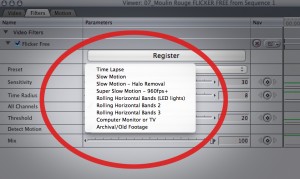
Digital Anarchy’s Flicker Free plug-in is supported in most major editing platforms. It will work either very well. Or not at all.