Archive for the ‘Craft of the Video Shooter’ Category
 Failing Media Education in the West: What’s Wrong With This Picture
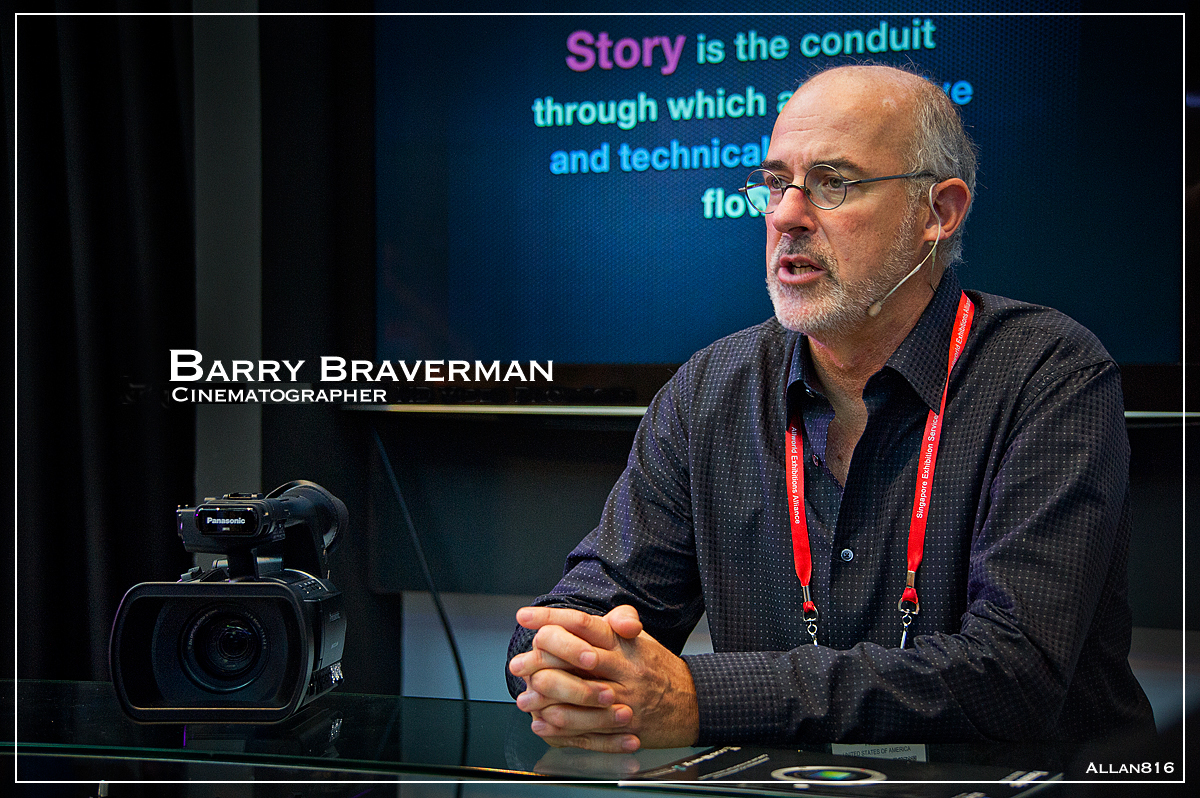
Barry Braverman at Singapore Broadcast Asia 20 June 2012
This week I’m in Singapore at Broadcast Asia where I’m presenting a series of mini camera workshops from the Panasonic booth on the expo floor. It is obvious to everyone that South Asia and Southeast Asia have emerged as the new epicenters of technology implementation and future growth. It is just as clear based on my professional work and recent workshops in Asia and Africa that the quality of media education in the United States is failing and that professional opportunities in general in the U.S. and Western Europe will continue to diminish in the next decade. It could be simply due to the current economic malaise in Western countries, but I believe it is due to something else, something more insidious.
About six months ago I was invited to conduct a workshop at a prestigious university outside of Paris. My invitation had to apparently clear a number of daunting obstacles including requisite permissions from the dueling teachers unions that are currently wreaking havoc in universities across the country. Ultimately my invitation was denied due to my insufficient qualifications, most notably my ongoing lack of a PhD. It’s bizarre that with thirty-five years of experience on high profile feature films and documentaries, three books, extensive teaching experience in camera training workshops around the world that a PhD from an insolated acadamic institution should rule the roost.
In America a near-comparable level of bullshit applies as academics and their allies conspire to deny their students the media skills they so desperately need. No such restrictions exist however for film and TV schools and universities across Asia.
Here the demand for proficiency and storytelling skills in the media trumps all other considerations. In Bangladesh five new Dhaka TV stations are coming on line in 2012, and station managers are lamenting the lack of sufficiently skilled workers to fill the exploding number of jobs. These days from Bangladesh to Sri Lanka I can assure you no one is asking a PhD from skilled film and TV professionals willing and eager to share their expertise with students and others aspiring to join the burgeoning media workforce.
Perhaps economic desperation in Europe will help motivate the necessary changes in education and the teaching of media crafts. Any way you look at it the the current state of media education in the West is not a pretty scene to behold.
Report from Cannes
 It isn’t too often I have the opportunity to walk the red carpet and hobnob among the industry elite, and, to tell you the truth, with the nearby likes of Bruce Willis, Ed Norton, Jason Schwartzman and Tilda Swinton, I received something less than zero notice strolling up the stairs into the Palais. I shot second unit camera on Moonrise Kingdom, specifically aerial work from the seaplane and several other scenes, and was in Cannes to support my long-time friend and director Wes Anderson, with whom I’ve had a mutually inspiring relationship ever since our first collaboration on Bottle Rocket over twenty years ago.
In many ways Moonrise Kingdom was perfect to open the festival. Owing to its strong artistic underpinnings and Alexandre Desplat’s very French musical score, the film’s European sensibility is amply reflected in the director’s imprimateur, which is evident in virtually every scene, frame and composition.
Inside the Palais on a sixty-foot screen the digitally projected film appeared breathtaking, and the Super 16-originated production held up extremely well at high magnification, thanks mostly to today’s superior film stocks and Zeiss lenses. In fact, virtually the entire show was shot with Zeiss Super Speeds, specifically the 9.5mm, the beauty and versatility of this now vintage 16mm format lens being apparent throughout the production.
If you’ve never been to Cannes let me just say the festival can be WAY over the top. Between the swarming crowds, screaming paparazzi, run-amok star worship, and the world’s rudest waiters brought in from miles around to man the local cafes, the festival can be a challenging ordeal to navigate and somehow enjoy.
Still the presentation of Moonrise Kingdom in such a venue, before an adoring and appreciative international audience, was a joy to behold. My minor role in the production notwithstanding, it helped restore my faith in the industry, that it is still possible to produce compelling film art exhibiting a high degree of craft and grace.
Production Bangladesh Style
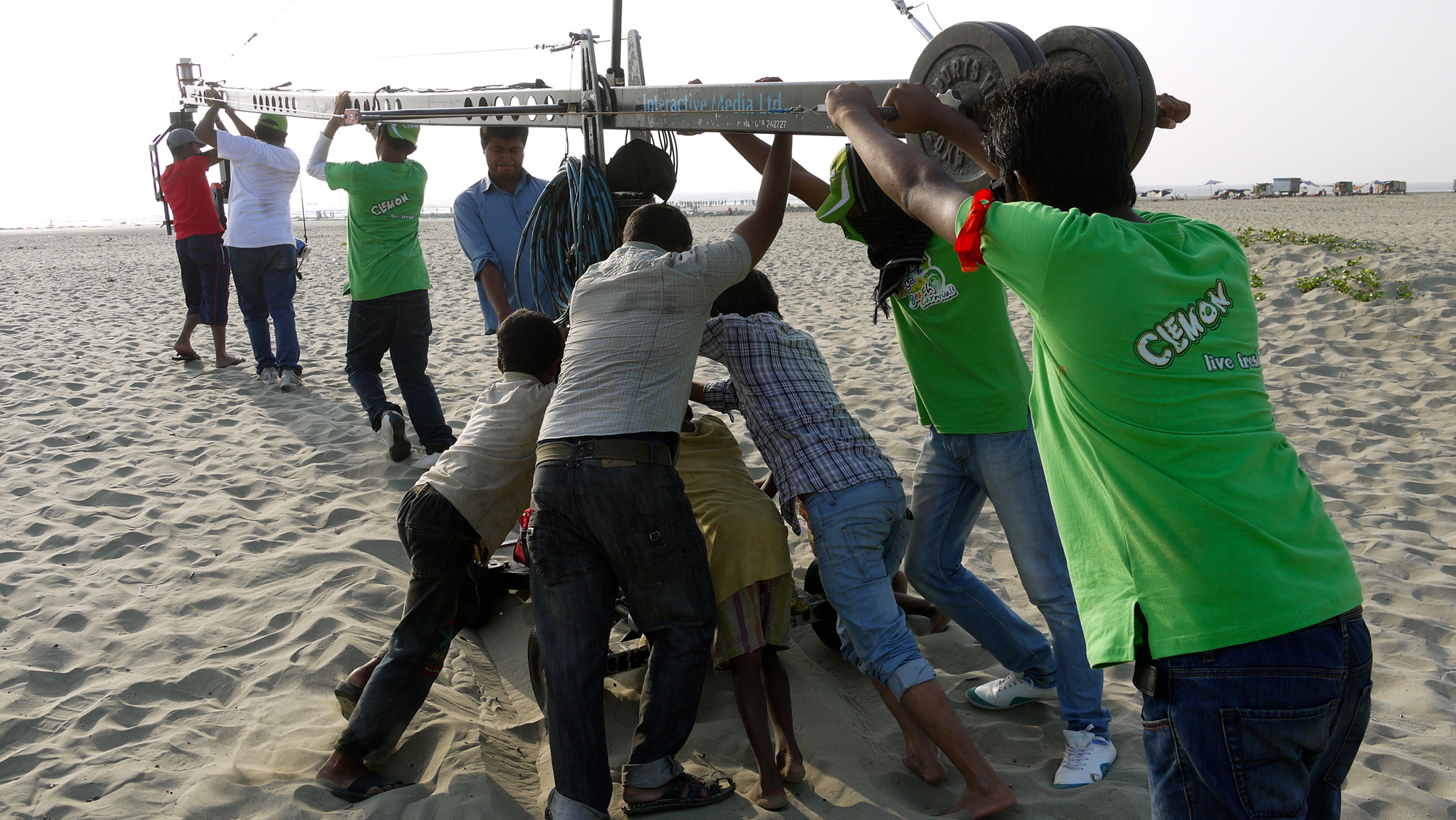
I spent most of March and April in Bangladesh where the market and opportunities for filmmakers are growing exponentially. There is excitement in the air as the country’s rapid growth is producing a shortage of skilled shooters and program producers. Four new TV channels in Dhaka are coming on line this year. In this scene the production grip “crew’ inclusive of several volunteer beach children help force the camera crane through the deep sand at Cox’s Bazar on March 26 Independence Day.
Just Say No to 8-bits!
That’s a tall order these days. If you’re shooting HDCAM, XDCAM, HDV, AVCHD or, heaven forbid, standard definition DV, you are capturing the world in a mere 8-bits. In all its sophistication and wisdom your camera’s processor outputting 8-bits to the recording medium can only assign one of 256 possible values to each sample; which can severely limit the color fidelity and smoothness of gradients in your images.
Ten-bit recording formats like the pricey HDCAM SR and Panasonic’s more economical AVC-Intra ought to be where we are heading. Manufacturers have leaped full bore on the high resolution sensor bandwagon, but for our bread and butter assignments upon which we depend every day, the 10-bit capture formats offer far better performance with fewer headaches at the end of the post-production rainbow. Our NLEs employing Apple ProRes or Avid DNx are already supporting 10-bit workflows so it simply makes good sense to utilize this greater bit depth and precision from the outset.
Beware of 8-bit cameras like the Sony F100, Panasonic AF100 and even the new Canon C300 that offer high resolution but at a mere 8-bit capture and meager 8-bit output via HD-SDI. This workflow is compromised from the outset, and can very well impair precise color correction and compositing downstream.
Panasonic HPX250 10-bit P2 Camcorder Goes to Prague
I’m currently in Prague working with students from FAMU, the national film school located here. While the workshop over the last week mostly covered 3D fundamentals and storytelling the class and I also had the opportunity to try out the Panasonic’s latest compact P2 camcorder – the AG-HPX250 – an economically priced 10-bit model that captures to AVC-Intra 4:2:2. Given the camera’s compact configuration and 22X macro zoom this is one powerful handheld beast. And the pictures captured in a wide range of conditions certainly bear that out.
Despite the camera’s diminutive size its performance can only be described as remarkable as my group and I shot around the old city in driving rain and sleet into the night and before dawn with startling results . I often fantasized about just such a camera that can perform this well in such a tiny package. Navigating across the historic Charles Bridge before dawn the camera supported by a Sachtler DV6 were the perfect combination: lightweight and flexible at a full-range of focal lengths and frame rates from 1-60 FPS.
The HPX250 with an MSRP under $6000 does entail a few notable compromises however, including several that are maddening: the bayonet lens-shade mounting system is needlessly imprecise and frustrating; the camera’s tiny flimsy controls, especially the menu selection toggle, are virtually impossible to operate with gloved hands, the rotating main power/mode switch is awkward to engage; and the miniscule release tab controlling access to the P2 cards is poorly designed and implemented.
Despite the operational tradeoffs the camera is sure to set the new benchmark in high-performance compact camcorders. Every camera of course comes with its own set of compromises. And this camera is no exception.
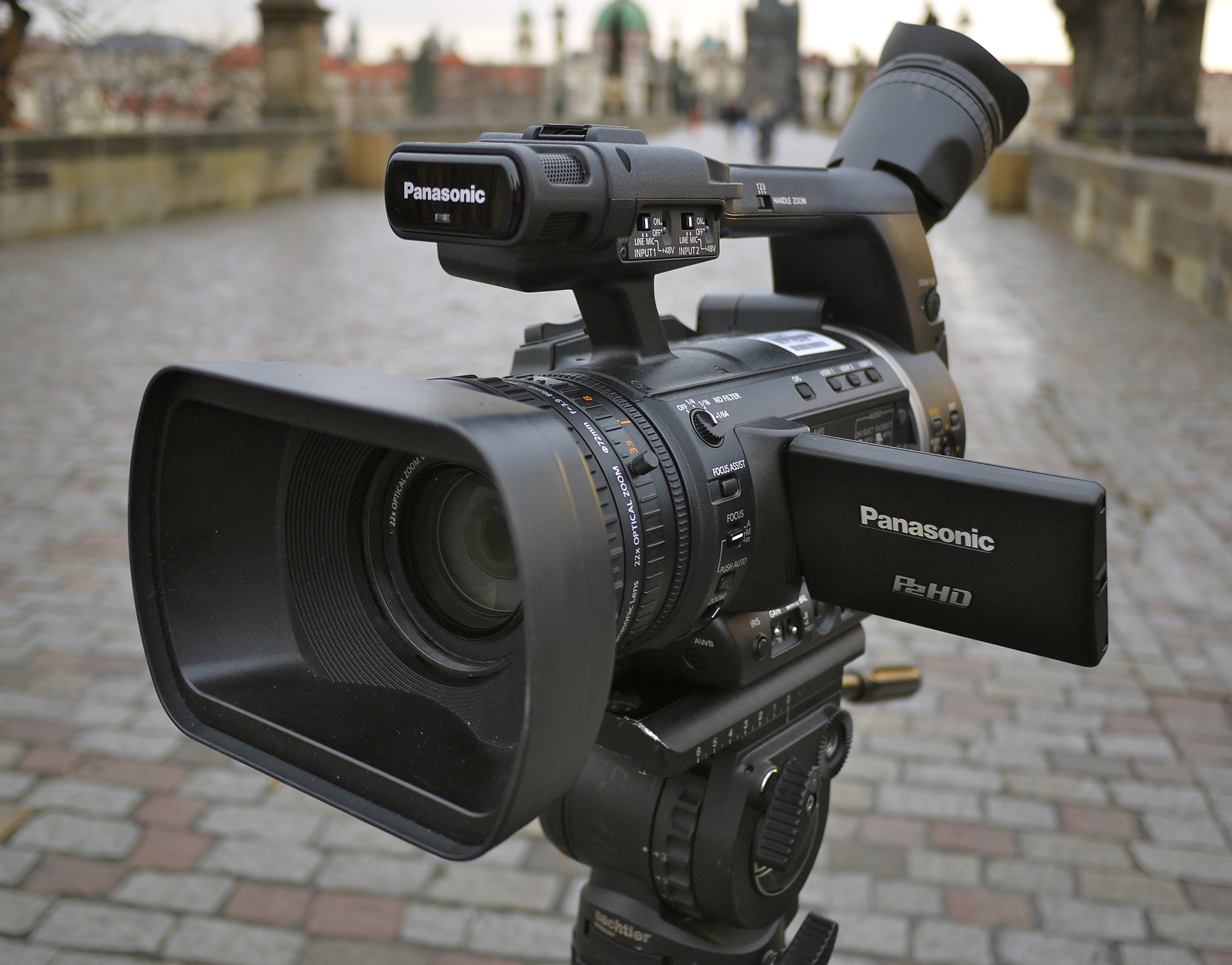
The HPX250 in Prague. December 2011.
Seeing Red in 3D Quality Control

Comfortable 3D viewing requires matching left and right eye photography. The QC session can help identify obvious faults.
I recently spent a morning at Technicolor’s 3D quality control lab in Glendale CA and was extremely impressed with the sophistication of the QC teams and the review process. Graphical software developed by Technicolor enables the QC operator to accurately assess hyper-divergent and hyper-convergent scenes. No remedial action is performed at this point; the process is solely intended for informational purposes, to alert the filmmaker of potential problems that might impact the viewer’s comfort and overall experience.
Only four pixels of vertical disparity will pass muster in the QC suite so left and right cameras with even the slightest mismatched geometry are readily identified. Color discrapancies and synchronization issues affecting the left and right eye are also easily spotted and flagged. Truth is, under this level of scrutiny, virtually every 3D project ever produced, regardless of budget, will return a bevy of red trouble flags.
The filmmaker’s challenge then is to somehow separate the redness of the QC report from his or her legitimate storytelling goals. The creative requirements of visual storytelling in the third dimension necessarily precludes following too closely the dicates of the QC session. Producers may look upon the report’s red areas, a hyperdiverged background, for instance, in the corner of a scene, and lambaste the stereographer, director and DP, but is this “fault” so identified in the QC report really a defect that will detract from the viewing experience?
Let’s keep in mind that story above all must drive the technology, not the other way around. Audiences do not determine their like or dislike for a 3D program based on the green versus red ratio in a QC report. Yes, the report can be extremely useful to identify clearly disturbing 3D conditions, but it should serve as gospel to compel changes in the storytellers’ creative choices.
My One-Day Vacation

1937 Raleigh Roadster: the mechanical world that used to be.
This entry doesn’t have much to do with the digital craft or video storytelling, although in a way it has everything to do with it. Today I’m in Wales fetching a 1937 Raleigh Roadster with a three-speed Sturmey-Archer and 28 X 1.5-in tires. When this cycle was manufactured in Nottingham two years before the outbreak of World War II there was little about it that one of average or sub-par intelligence couldn’t understand. After all this elegant machine is the quintessential mechanical device with rod-actuated brakes; the three-speed internal gearing integrated into the rear hub operated by a a push-pull cable engaging the planetary gears.
We lived in a mechanical world then, and when something went wrong with the Raleigh Roadster, it was a simple fix – easy to figure out, and easy to remedy. On the other hand, today it accomplishes little to break open a DVD player’s case and stare down a microprocessor. Troubleshooting in the digital era requires insight and understanding of theory, bits and bytes. That takes training and discipline and ongoing study.
So today I am thankful and grateful: my latest cycle acquisition is blessedly devoid of the digital complexity that defines our time.
Greetings from Zanzibar
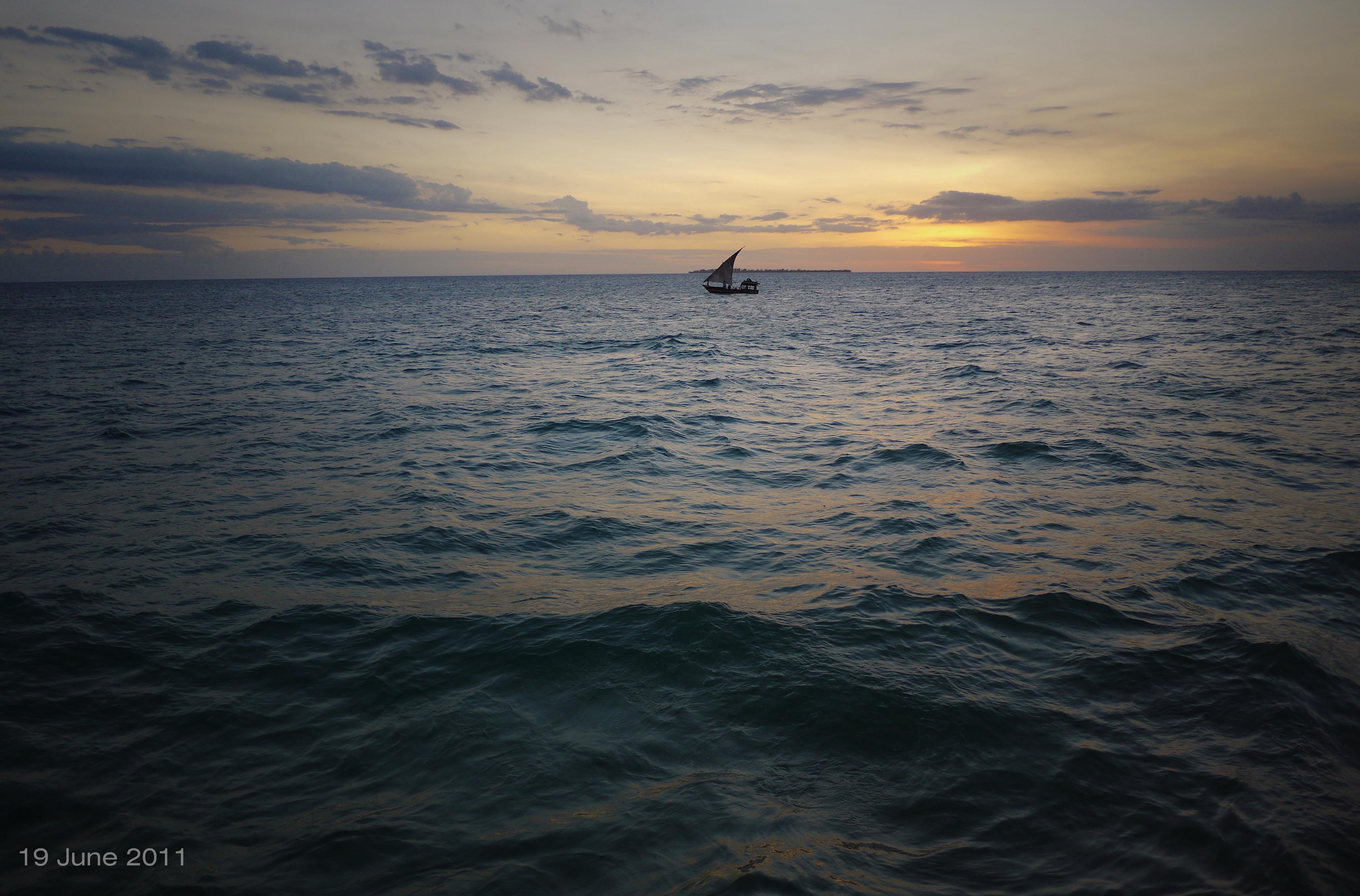
A traditional Zanzibari dhow crosses the horizon near Stone Town, Zanzibar, 19 June 2011
The East African community is awash with fabulous stories itching to be told, and that’s certainly been my impression this week as I’ve led a camera storytelling workshop here at the Zanzibar International Film Festival (ZIFF) running through 26 June 2011. Many times I’ve said that I always receive far more from my overseas workshops than I give in return; the local filmmakers being so grateful for the guidance and insight that I can provide them.
I have noticed however an interesting paradox among the filmmakers pitching their documentary ideas during this morning’s pitching sessions. First, there was the preponderance of misery-themed proposals: the poisoning of a river at a copper mine in Zambia, a massacre of villagers in Kenya in 1926; the rise to power of a warmonger in the Sudan. For Westerners these subjects while interesting hold diminishing appeal; indeed much of the world has grown weary of the near constant tales of woe and despair across the Dark Continent.
I am far more interested in the countless little stories here in Zanzibar and in the rest of Tanzania that far better illuminate the nature of daily life in this part of the world. Several recent polls of the world’s people have consistently shown East Africans to be among the happiest people on earth, far happier, for example, than the Swedes, the French, or the Canadians. Some things are definitely going right about the quality and character of life here, and I for one am dying to see more of those stories, and less of the disease, depravity and colonial victimization subjects that seem to be so dominant among many of the filmmakers.
It will be very interesting to see the finished productions on Sunday night, and see if I’ve had any noticeable impact on the filmmakers in my workshop, not only from the perspective of raw skills and craft, but also from the point of view of the choice of subject matter itself.
Why Micro Four-Thirds Makes Sense
One of the reasons frequently cited for the current fad among shooters demanding larger and higher K cameras is this little matter of depth-of-field. Advocates for battleship-size imagers in cameras claim that a narrow depth of field is essential to producing first-class work, and that no self-respecting shooter would be caught dead shooting with a – oh God, no, heaven forbid — a 1/3-inch traditional camcorder. Never mind that one’s choice of optics is far more important; indeed one’s choice of lens can account for most of the professionalism that an audience can perceive on screen. Sure the RED and the DSLR craze has propagated this notion that bigger must be better; do I have to remind you that this “bigger” mentality has prevailed among many races of men since time immemorial?
When it comes to imager size in professional video cameras I would assert that quite the reverse is often true. If you’re shooting 3D we WANT as much depth of field as we can muster, which gives the smaller imager in a camera, say, 1/3-in to 2/3-in, a significant advantage. Likewise if we’re shooting wildlife in Tanzania we usually prefer increased depth of field to compensate for the focal length lenses we tend to use.
On the other hand when a shallower depth of field is legitimately demanded, the Micro Four-Thirds format championed by Panasonic and Olympus provides an optimal solution. The 22.5 mm diagonal offers the inherently shallow focus for narrative-type shows, as conditioned over many years by our collective 35mm cine experience. This desirable range of focus is much more readily and practically achievable in the MFT format, without the peril of the nose in-focus/eyes out-of-focus syndrome that plagues users of the Canon 5D for example.
My point here is that craft rules the roost, or at least it ought to; a larger imager with more Ks is NOT better, unless your particular brand of storytelling demands such a treatment. And inasmuch as larger imagers demand proportionately better optics, it simply means we should determine our camera and imager size needs according to the quality of optics we have at hand.
And keep in mind this one inescapable fact: If you’re planning to use a consumer still lens, regardless of your camera’s sensor size or resolution, you can only attain consumer grade images! Think about it.
When ‘Good Enough’ Is ‘Good Enough’
From YouTube to cable TV, from iPhone video to RED cameras, there is a common mentality sweeping the industry. I call it the ‘Good Enough’ syndrome. This is the mindset that weighs the benefits of convenience and low-cost, and says, in any given application that image quality and image integrity is ‘Good Enough’. Perhaps this is the way it should be, given the current economic reality. Still, I can’t help giving credence to the ‘Good Enough’ camp in at least one critical way: When it comes to very high resolution cameras – 4K, 5K and higher – in the great majority of cases HD or 2K resolution is, well, good enough.
It’s not that I can’t see the benefit of shooting higher resolutions for digital cinema and other big screen applications. My point is rather we also need the appropriate work flow to support such high resolutions – in post-production, storage and archiving. These are all systems that require serious expansion to accommodate the much heavier data load from 4K and 5K image capture.
And then there is the question of optics. We all know that 4K and 5K cameras do not necessarily produce 4K and 5K images – in fact they rarely do. The fact is that such very high resolution sensors capture not only greater picture detail which presumably we do want, they also capture much greater lens defects, which we almost certainly do not want.
So unless you like seeing ugly fringing in your images with rampant chromatic aberration, be especially mindful of the quality of optics used with your latest and greatest high resolution camera. It’s not just that “good enough” is sometimes actually good enough. It’s more that one must consider the entire picture and not just the native pixel count of a sensor.