 Sony FS700RH: Economical 4K But We Need the Optics To Go With It
It goes without saying the FS700 performs very well. At 4K its images have a pleasing organic look that can be honed or tweaked during grading and finishing almost without limitation. In pro-level cameras the SDI output is typically 10-bit but in RAW mode the FS700 outputs a 12-bit proprietary signal via 3G-SDI. Sony has thus far not permitted third parties like Convergent Design to capture the 4K RAW data. For this shooters must use Sony’s 4K recorder and interface – the AXS-R5 coupled to the HXR-IFR5.
Aside from the storage and associated workflow issues the real drawback to 4K image capture is the need for high-quality optics; satisfactorily capturing high resolution images in 4K demands the highest performance (i.e. expensive) lenses we can find to offset the increased visibility of once well-concealed optical defects.
Recently I had the opportunity to shoot with the updated FS700 for SPACE COWGIRLS, a new web series written by Allyson Adams and directed by Adele Slaughter. The vintage Canon FD series lenses available offered a nice range of focal lengths from 20mm to 135mm with decent functionality. Still I couldn’t help but notice at 4K resolution their less than stellar performance: reduced contrast, increased flare, curvature of field, and many visible chromatic aberrations, The FS700 recording in 4K may indeed be the most economical solution around, but let us recall that 4K capture doesn’t in and of itself produce 4K images; we still need the appropriate optics to go with it.
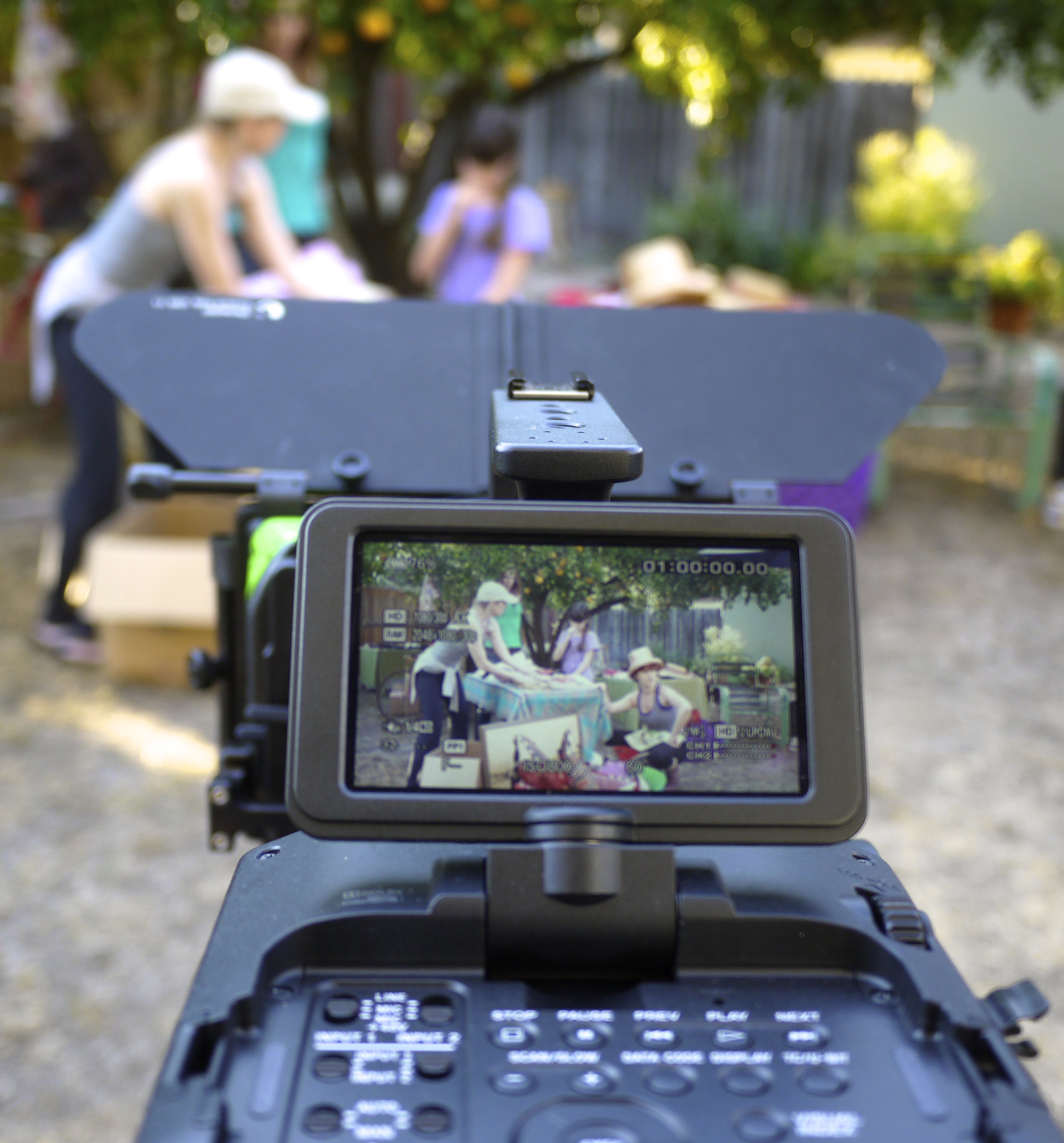
The Sony FS700RH on the set of SPACE COWGIRLS, directed by Adele Slaughter.
What’s Really Important Is Not the Technical Crap
Then why the obsession with tech chatter in the many online forums? What is it about tech talk that we find so engaging and enthralling?
In the mid 1980s, the toy company Fisher-Price manufactured a 2-bit monochrome camera that recorded to an ordinary audio cassette. Pixelvision’s cryptic images continue to attract storytellers today, despite, or more accurately due to its obvious lack of technical sophistication. The fact is that stories work for different reasons, and can often be quite successful despite a lousy script, poor lighting, or even I shutter to say, bad camerawork.
Audiences can’t care less if you shoot your story on NXCAM, 35mm Cinemascope, or your iPhone. No one walks out of a movie theatre and says, ‘Gee, that was a great movie but it was shot 4:2:0’. So as you read this blog and perhaps glean something useful from it let’s keep all this tech talk in perspective.
Who Needs 4K?
NAB 2013 has come and gone and the prevailing themes this year were clear: cloud-based storage and collaboration and the advent of 4K acquisition. My question is who needs 4K? If you’re shooting a movie destined for the big screen then 4K origination certainly makes sense along with use of the appropriate lenses and a lightly compressed recording format. Short of cinema applications and perhaps broadcast for cutting out multiple HD frames the point of 4K acquisition escapes me.
I expressed this perspective at a recent trade gathering of cinematographers and manufacturers and was roundly booed. My father who bathed extremely infrequently often questioned ‘why clean is better?’ I would like to offer the analogous thought for the vast majority of today’s shooters: Why is more resolution better? Why is 4K desirable?
Please tell me. I’d like to know.
Motivating the (supposedly) Unmotivated
This week I have been providing basic camera visual storytelling training to staff cameramen at television broadcast facilities in Kuala Lumpur and Singapore. Having offered such training numerous times in the past for the commercial production community I was informed in Southeast Asia that the news cameramen are particularly lazy, unmotivated, and lacking in creative energy.
Nothing could be further from the truth! What I found at the news channels in Malaysia and Singapore were teams of motivated craftsmen eager to express themselves with more cinematic penache. Curiously I discovered the same thing among the producers and writers who also participated in the training. From every quarter there seemed to a pronounced willingness to produce more visually compellling work in the news and current affairs genre. What is missing it seems is a clear mission statement from news directors, station management, and labor unions, that it’s worth the effort for a shooter to try hard and produce outstanding work. It’s not a question of money; it’s really a matter of recognition, that the managers who mete out the shooters’ daily assignments will welcome and appreciate the extra effort and higher standard.
News crews in SE Asia are eager, able, and ready, to provide more compelling visual content, if station managers will simply allow them.
3D Interest Surging (Again) in SE Asia
We’ve seem this before in 2010 and now again in 2013: a renewed interest in 3D workshops and training. This week I am finally out of Dhaka and leading back-to-back 3D training sessions in Singapore, at MediaCorps’ educational academy SMA, and at NYU Tisch Asia.
The reason for the surge in interest seems counter-intuitive. The recent success of Life of Pi notwithstanding theatrical 3D has been losing ground and audiences for several years. The anticipated boom in demand however for non-theatrical 3D programming appears to be the big factor this time with the arrival of a 3D iPad and iPhone in late 2013 or 2014. There is an imperative for media training institutions across the region to remain relevant and on the cutting edge as they see it appropriate once again to offer 3D training opportunities for their students.
NYU Tisch students practice their 3D skills during a workshop at the university’s Singapore campus 23 Feb 2013.
Uh oh. Fire at Annapurna Studio
No one was killed in the devastating fire that destroyed half the studio in Hyderabad last week but the substandard electrical practices that led to it will almost certainly ensure more such fires occur in the future.
In less than an hour the sound stage and sets at Annapurna Studios were reduced to a pile of ashes, and for the film school that shares this space the lesson couldn’t be clearer: Better adopt some basic electrical safety standards and adopt them fast. The studio management to its credit had recently tried to impose a safety code but the veteran “electricians” who caused this fire appear to have little interest in updating their skills or lack thereof.

Fire destroyed the largest sound stage at Annapurna Studios in Hyderabad India 14 January 2013.
Emoting Actresses in Hyderabad
I’m in Hyderabad this week and working with a joint filmmaking group from Annapurna School of Film and Media and Chapman University. I sometimes forget that India has the largest film industry in the world, and as such has evolved its own style of acting that can only be described as big and over the top.

Scene from Proud Mothers shooting in Hyderabad. 17 January 2013.
The Spirit of Southeast Asia
This month I am leading a series of camera workshops in Kuala Lumpur and am duly impressed by the spirit of my students and overall level of media activity here. While the mood in the US and UK can only be described as glum it is certainly not the case here where aspiring filmmakers and content creators of every type appear eager to learn the old cinematographer’s skills in combination with the new camera technologies.
In the coming months I will be venturing on to Hyderabad and Dhaka, where demand for skills and training is high. With four new television stations having come on line in Dhaka this year facility managers are hard pressed to find sufficient qualified workers to fill the available positions. No doubt the economic growth in Malaysia and throughout the SE Asia region is fueling the demand for media professionals but it is also an intrinsic yearning and high value placed on education in general in these societies that are playing a large role.
A stage show at Panasonic Showcase Malaysia artfully blends the traditions of regional dance and the latest display technologies. 13 December 2012.
The DSLR Wannabes
The line between still and moving is rapidly blurring as the latest generation DSLRs become more robust and capable as professional video cameras. The addition of SMPTE timecode in the Canon 6D and Panasonic GH3, in addition to manual audio levels and more extensive control over exposure and frame rates, suggest that that the line may disappear entirely before very long.
The DSLR can’t thwart the laws of physics, however, and the camera’s diminutive bodies and lack of proper heat sinks cannot quite yet tackle the processing loads demanded by today’s sophisticated shooters. To shoot HD RAW the DSLR would need to increase its on-board processing power on the order of 20 times, a development that is simply not in the memory cards anytime soon.
So the DSLR for all its expanded video capabilities and functions will remain several orders of magnitude below a true video camera for the foreseeable future. If you study the media landscape and examine popular camcorders like the Panasonic AF100, Sony FS100, and Canon C500, you see cameras that have been profoundly influenced by the DSLR.
No doubt that will continue to be the case as DSLR wannabes multiply and join the fray in 2013. I don’t see it being any other way, given that Canon appears to be the only profitable manufacturer of cameras these days.
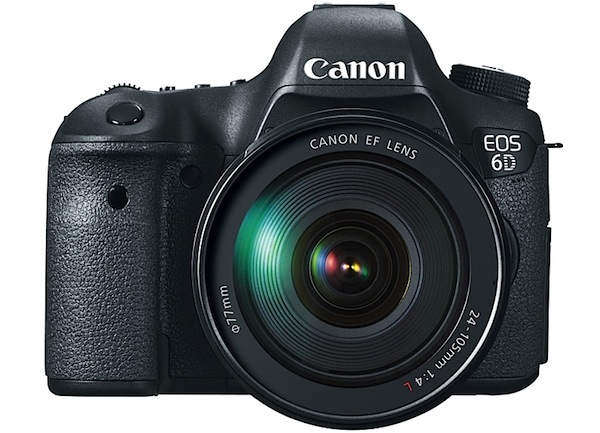
Canon 6D. Cheaper more powerful DSLR with WiFi.
3D Training in the UK
The moribund state of 3D has left manufacturers and broadcasters in a state of bewilderment and deep despair. Yet if I’m correct this is about to change in a BIG way with the arrival next year of 3D tablets and mobile phones. The advent of huge numbers of these devices will usher in a vibrant new 3D era, this time driven by non-theatrical applications, from sports and music videos, to remote education, corporate, and medical research.
This week I am in London leading a 3D Camera & Storytelling Workshop for young cinematographers, producers, and directors, at the National Film and Television School. It is a testament to the school to recognize that students must possess fundamental stereo skills in the media world of the very near future.

3D Education at the National Film and Television School London • 29 October 2012