 Why Micro Four-Thirds Makes Sense
One of the reasons frequently cited for the current fad among shooters demanding larger and higher K cameras is this little matter of depth-of-field. Advocates for battleship-size imagers in cameras claim that a narrow depth of field is essential to producing first-class work, and that no self-respecting shooter would be caught dead shooting with a – oh God, no, heaven forbid — a 1/3-inch traditional camcorder. Never mind that one’s choice of optics is far more important; indeed one’s choice of lens can account for most of the professionalism that an audience can perceive on screen. Sure the RED and the DSLR craze has propagated this notion that bigger must be better; do I have to remind you that this “bigger” mentality has prevailed among many races of men since time immemorial?
When it comes to imager size in professional video cameras I would assert that quite the reverse is often true. If you’re shooting 3D we WANT as much depth of field as we can muster, which gives the smaller imager in a camera, say, 1/3-in to 2/3-in, a significant advantage. Likewise if we’re shooting wildlife in Tanzania we usually prefer increased depth of field to compensate for the focal length lenses we tend to use.
On the other hand when a shallower depth of field is legitimately demanded, the Micro Four-Thirds format championed by Panasonic and Olympus provides an optimal solution. The 22.5 mm diagonal offers the inherently shallow focus for narrative-type shows, as conditioned over many years by our collective 35mm cine experience. This desirable range of focus is much more readily and practically achievable in the MFT format, without the peril of the nose in-focus/eyes out-of-focus syndrome that plagues users of the Canon 5D for example.
My point here is that craft rules the roost, or at least it ought to; a larger imager with more Ks is NOT better, unless your particular brand of storytelling demands such a treatment. And inasmuch as larger imagers demand proportionately better optics, it simply means we should determine our camera and imager size needs according to the quality of optics we have at hand.
And keep in mind this one inescapable fact: If you’re planning to use a consumer still lens, regardless of your camera’s sensor size or resolution, you can only attain consumer grade images! Think about it.
To Sell 3D We Need to Build a Community First
Many industry folks are currently lamenting the slow uptake of 3D by the general public. They look at the sluggish sales of 3D plasma TVs this past Christmas and conclude that 3D must be doomed in the home market. Nothing could be further from the truth.
The fact is that the marketing in general of 3D in general has been abominable, especially in the US. Is it any surprise that sales of 3D TVs are lagging when there is little to no quality programming to fill those screens?
Content is king. It’s why VHS and DVD succeeded in the home – and it’s why 3D will ultimately succeed for the same reason.
What the manufacturers should be doing is not so much pushing this 3D plasma or that 3D camera. What’s most critical now is to sow the seeds of new and vibrant 3D community, particularly among young filmmakers and energized content creators in our nation’s colleges and universities. It is in our nation’s schools and in the universities and film schools overseas where the real strides will be made as students apply their natural God-given enthusiasm to 3D and create of programs of grace and lasting beauty.
I’m seeing this first-hand in India, and there’s no reason the same effort at community-building couldn’t be happening in other countries.
After this past year of missteps and poorly conceived marketing the major manufacturers are slowing waking up to the fact that 3D cannot be marketed as just another camera format or latest generation TV technology. This approach that worked so well for HD and the latest cameras like the Sony EX and Panasonic HVX will not work this time, as the past year has certainly proved the point.
Let’s build the 3D community first – in our schools, corporations and in our communities – and soon the public will follow. Then maybe – if the manufacturers play their SDHC cards right – a few sales of TVs, cameras and all the rest might follow after that. 🙂
India Gets It Right
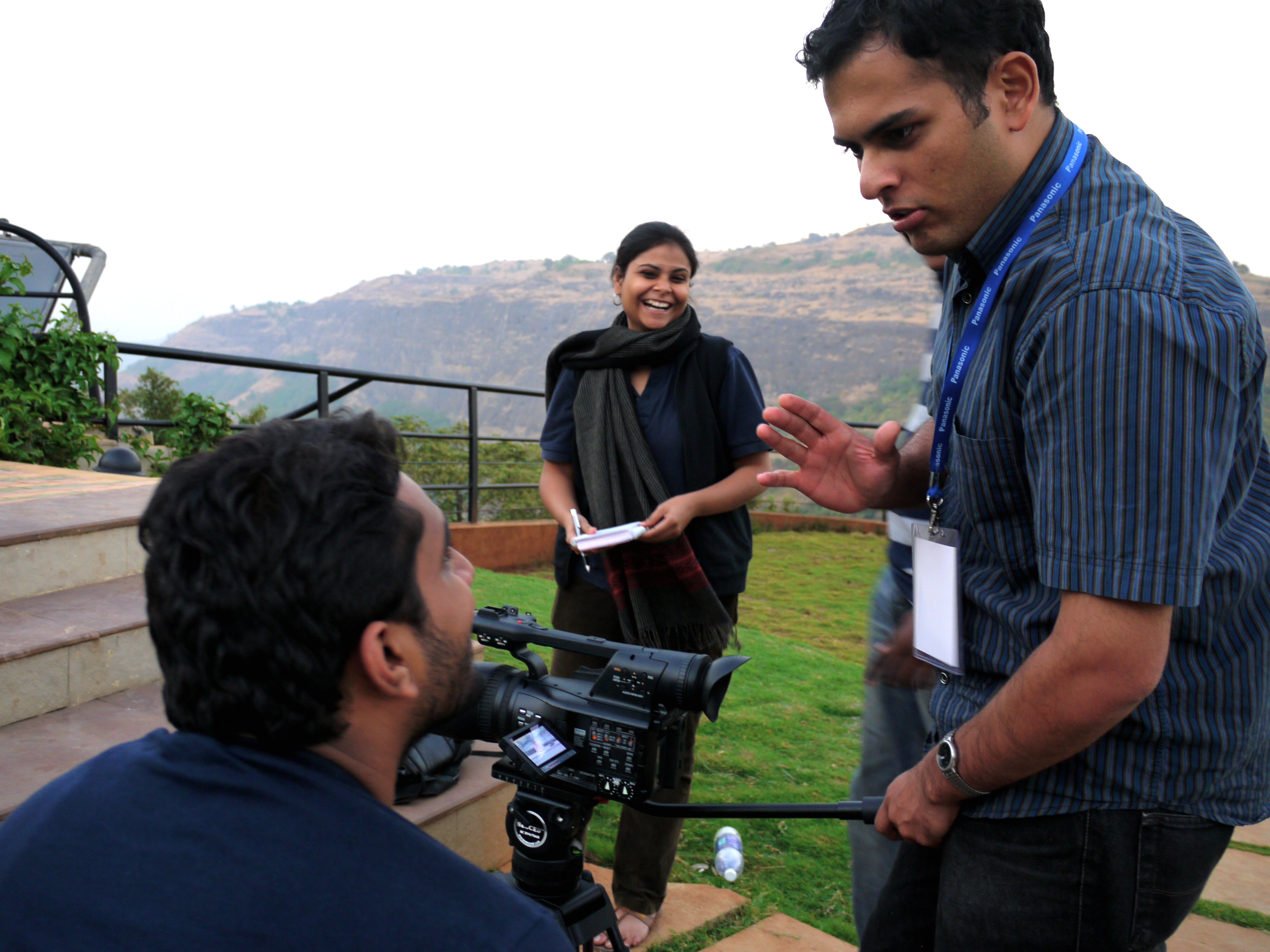
The Panasonic 3DA1 one-piece camcorder is an excellent tool for teaching effective 3D storytelling skills.
I’m back in India now conducting another in a series of 3D camera workshops featuring the Panasonic 3DA1. This time I am training TV and cinema students from around the country participating in a 3D Movie Making Contest.
Unlike other 3D workshops, this one is focusing not so much on the camera per se, but rather on the art and craft of 3D filmmaking. This is what we ought to focus all of our camera workshops: on story, story, story. After all as Sidney Lumet so aptly said (more or less) story is the conduit through which all creative and technical decisions flow.
So the rudiments of good story and good camera craft must necessarily go hand-in hand. This four-day workshop being conducted two hours out of Mumbai is looking at 3D storytelling as a craft onto itself, with the details of camera, workflow and concomitant skills coming into play only so much to fulfill one’s storytelling goals.
The compact integrated 3D camcorder fits beautifully into this enlightened mindset, as the simplicity of the tool allows much greater emphasis on what really matters to audiences.
In the future I’m hoping to pursue more workshops like this one, where the demands of story come first, and the technical details (as important as they may be) assume their proper supporting role.
When ‘Good Enough’ Is ‘Good Enough’
From YouTube to cable TV, from iPhone video to RED cameras, there is a common mentality sweeping the industry. I call it the ‘Good Enough’ syndrome. This is the mindset that weighs the benefits of convenience and low-cost, and says, in any given application that image quality and image integrity is ‘Good Enough’. Perhaps this is the way it should be, given the current economic reality. Still, I can’t help giving credence to the ‘Good Enough’ camp in at least one critical way: When it comes to very high resolution cameras – 4K, 5K and higher – in the great majority of cases HD or 2K resolution is, well, good enough.
It’s not that I can’t see the benefit of shooting higher resolutions for digital cinema and other big screen applications. My point is rather we also need the appropriate work flow to support such high resolutions – in post-production, storage and archiving. These are all systems that require serious expansion to accommodate the much heavier data load from 4K and 5K image capture.
And then there is the question of optics. We all know that 4K and 5K cameras do not necessarily produce 4K and 5K images – in fact they rarely do. The fact is that such very high resolution sensors capture not only greater picture detail which presumably we do want, they also capture much greater lens defects, which we almost certainly do not want.
So unless you like seeing ugly fringing in your images with rampant chromatic aberration, be especially mindful of the quality of optics used with your latest and greatest high resolution camera. It’s not just that “good enough” is sometimes actually good enough. It’s more that one must consider the entire picture and not just the native pixel count of a sensor.
Are you a specialist or a generalist?
I’m a firm believer that today’s shooters must possess a wide range of skills. In most markets the resident shooter must also edit, compress for the web, prepare DVDs, and de-noise sound tracks. Today the expectation is that every shooter is proficient in Photoshop, After Effects, and one of the major NLE platforms, like Final Cut Pro.
Students today who are likely to find ready employment after graduation should be able to handle anything that might arise on a modern production, by that I mean, he or she must be able to confidently troubleshoot a range of issues beyond the immediate camera and recording media. Such a person – a problem-solver – will always be valuable and in demand, and so it’s just smart for film and video instructors to adequately prepare their students for this troubleshooter role.
In most markets the era of specialization ended with the advent of DV in 1995, although, admittedly, we still need well-groomed technicians in technologies like 3D. For most folks the setup of a 3ality rig with two Reds converging on a mirror is a process fraught with peril. So yes, a specialist with specific 3D camera setup skills is currently very much in demand. Considering the market as a whole, however, most productions benefit most from a generalist, that man or woman versatile enough to assume a wide range of responsibilities from script to screen.
What do the Indians know?
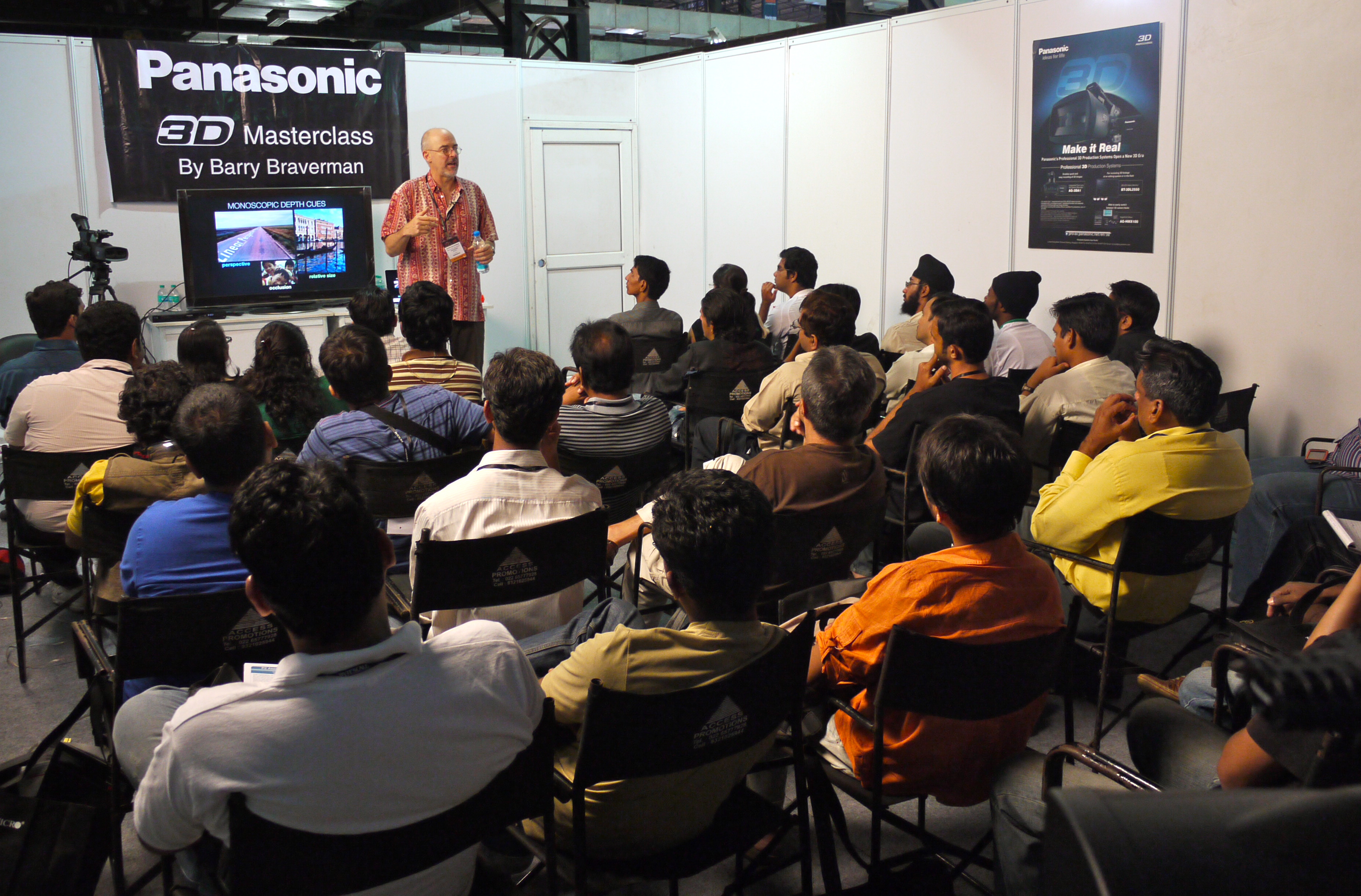 I’ve been in Mumbai for several weeks teaching 3D camera skills to eager Indian filmmakers. It makes sense to me that 3D should find a welcome home here. After all the Bollywood sensibility of four-hour epics with abundant song and dance numbers lends itself perfectly to the 3D format. Unlike most of the rest of the world the cinema is alive and flourishing on the subcontinent, with regular movie attendance continuing to grow each year. It stands to reason therefore that those of us who love cinema should pay increased attention to what used to be strictly Indian fare. The finest technicians in the world are practicing and perfecting their craft daily here. Where are the filmmakers in the rest of the world honing their skills now? There are simply too few large-scale productions elsewhere to produce highly proficient shooters and storytellers. Is this the result of the “democratization” of the digital medium we’ve heard so much about?
Our 3D Brains Can Be Very Forgiving!
In my 3D camera workshops I discuss in detail the requirement that both left and right cameras match geometrically and photographically as closely as possible. And this is true. Yet over and over again I see examples of two wildly out of color balance L-R images that nevertheless display satisfactorily. This example from a recent class exercise on the streets of Mumbai illustrates my point. One eye (left) is balanced for daylight at 5600º K., the other (right) is preset for interior tungsten at 3200º K. Not surprisingly when viewed separately we see the obvious disparity in the two images, yet when overlaid and viewed in 3D the blue cast in the right eye seems to magically disappear. The brain processing the conflicting images opts intuitively for the correct one!
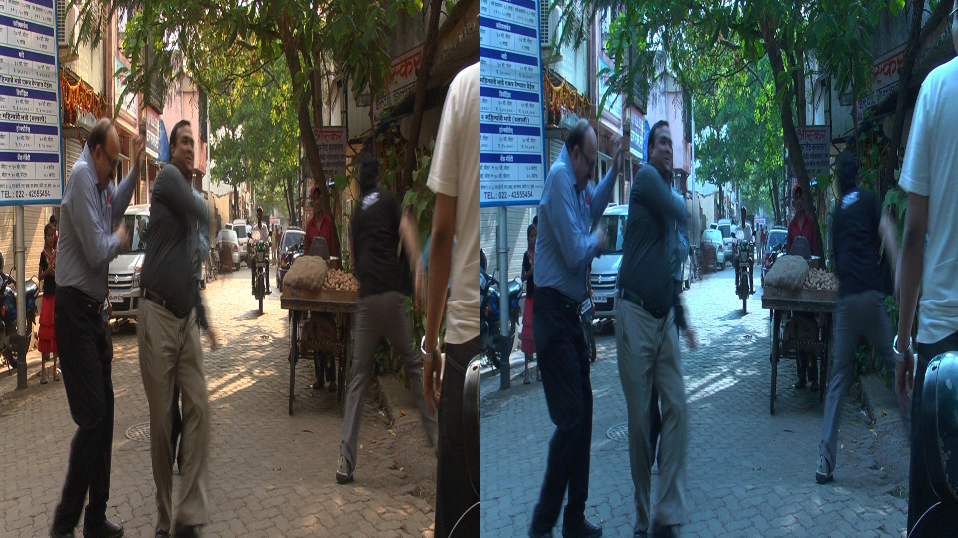
Daylight balance LEFT; Tungsten balance RIGHT
Narrow Depth of Field for 3D?
It stands to reason: one looks at the world and we expect to see objects in focus. Blurry backgrounds and soft focus may be all the craze with the DSLR crowd, but remember such narrowly focused scenes lack clear depth cues and will quickly disorient your viewers. With the advent of 3D, shooters must again embrace cameras and camcorders with smallish sensors; the 2/3-inch imager size appears to be ideal with optimal depth of field and dynamic range. And there’s one other thing: The new Panasonic 3DA1 which I’ve been discussing at length throughout Asia features a relatively modest 1/4-inch chip array (one 3 X MOS chipset for each eye). The camera is notable because the small sensor while offering exceptional depth of field also features remarkable low light performance. How can that be that a tiny 1/4-in sensor can offer such superb low light response even at a lofty +24dB gain?
The overlaying of the left and right images produces a noise cancellation effect. Our brains effectively cannot see or process the noise under such circumstances and therefore disregards it. The result is very little visible noise even at extremely low light levels.
3D in Asia Coming On Strong!
I’ve been on the road nearly constantly of late, traveling through Australia and Southeast Asia including Malaysia, Vietnam and India. The response to my 3D camera workshops has been overwhelming with shooters and producers emerging from seemingly out of nowhere to grasp the 3D gold ring. This response while intense across Asia has been somewhat more tepid across North America and Europe and I wonder why. This may be simply attributable to the poor economy in the US and elsewhere, but I think it may be something more. The Asian market seems much more willing in general to embrace new technologies. The cinema in general here, especially in India is also much stronger, offering a ready and eager vehicle for 3D Bollywood grandeur and glitz.
Beyond feature film production I’m also seeing a surge of interest in 3D from travel and tourism concerns, museums, and even wedding and event producers who seem eager to offer 3D programming. This is in Asia. This trend while taking root now is nowhere so apparent in the USA and Europe, where the current DSLR fad and the allure of a narrow depth of field still appears strong.
Depth of Field: Why is Less Better?
In the last few years the notion of reduced depth of field has resonated loudly with shooters. Many shooters opt for 35mm lens adapters or cameras with full- or nearly full-size imagers in order to exploit selective focus as a means to properly direct viewer’s attention inside the frame. The current craze for HDSLRs is an outgrowth of this thinking: that less depth of field is better.
Putting aside for the moment that the greatest film ever made, CITIZEN KANE, exploited maximum depth of field for spectacular effect, there is another reason to consider more depth of field and not less – 3D. In 3D audiences expect objects floating about an auditorium to be in (or mostly in) focus. When backgrounds are blurry or the object plane is not clearly defined, viewers will automatically place these objects at the screen plane, which may not be correct or even logical. Such disparities in logic can be a contributor to the dreaded 3D headache, and so must (usually) be avoided like a plague.
Consider that James Cameron in AVATAR could have used any camera he wanted, but he chose the Sony F950 with 2/3-inch CCD sensors. It turns out that 2/3-inch cameras for 3D applications offer the best compromise for dynamic range, low-light sensitivity and depth of field. That’s not to say that 3D cannot be shot with a RED. Of course it can – and it is. The real issue is the extra time and expense required to achieve the narrow stop and desired DOF, and this means lighting and grip – and lots of it.